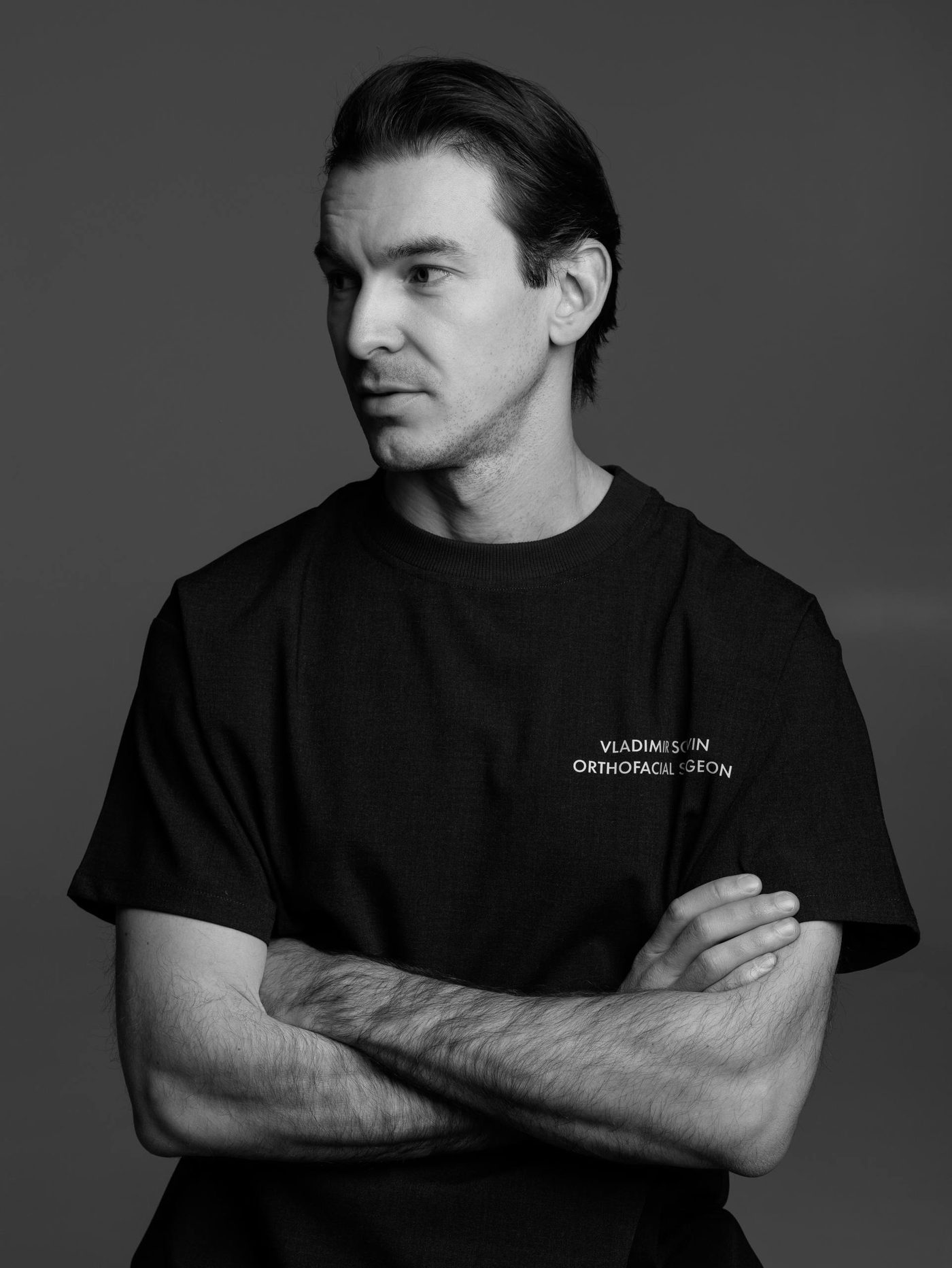
A conversation with the doctor
Of all the metaphors, the sculptor is the one closest to me: he strikes an image out of stone, its proportions, symmetry, movement, a single frozen frame. Everything else, the architect, the restorer, the engineer, is layered on top of that.
How do you look at a face when a patient first walks in?
The day of surgery is the final step, not the beginning. First I need to understand whether this is the right person and whether there is really something to work with: if you want to, you can find an indication for anyone. I look at the face as a whole, with taste, with a trained eye, with how the person moves and what their real complaints are. From the doorway, the brain already reads what sits right and what does not. Then it remains to listen to the patient: is what they have in mind the same as what I have in mine? If not, it is simply not a road we share. And the main thing: if I know the anatomy, I know where I am going, and therefore what I can honestly offer.
Where are you strict with yourself as a surgeon?
I am demanding of my own demands, strict with my own strictness. I will not leave the operating room until what was promised has been done to the maximum: not thirty percent, but the full ninety-five that is available; the rest is finished by nature. That is discipline, and over the long run discipline beats any talent. The standard does not depend on the patient's status or the complexity of the case: an easy, a moderate and a difficult operation are all performed at the same high level. Everyone has people close to them, a mother, a brother, a sister; I always imagine that they, too, could end up on my table, and I want them to be treated the same way.
What stays behind the scenes, what does the patient not see in their result?
Beneath the result lies control over every millimetre of movement. Many surgeons delegate the 3D planning and preparation; I keep it in my own hands: the plan has to be created by the surgeon himself and live in his head. There is no single template; you do not treat different people with one pattern. And I do not disappear after the operation: the patient has to be led by the hand from point A to point B. With rhinoplasty that is a couple of months, with orthognathic surgery a year or two, and after that we stay in touch for another year. There is a great deal of information out there, and almost all of it is incompetent; my job is to be the lighthouse you walk beside, not to set a person adrift.
Where, for you, is the line between medicine and art?
The line runs literally along the anatomy. If, artistically, four millimetres of bone need to be smoothed away but the nerve allows only two, I will stop at one and a half, short of the nerve: you cannot harm someone's health for the sake of art, even if the patient insists. The second line is not turning your own signature into a serial mistake. Classical harmony has clear lines, angles and corridors of the permissible; you cannot step outside them, just as love has a boundary beyond which it becomes passion or obsession.
What in your work is precise calculation, and what is an artistic decision?
First I draw the image, in my head and on the photograph, of how I want the result to look. Then I match it against the patient's real anatomy: the nerves, the vessels, the density of the bone. Where the anatomy allows, I go all the way; where I am limited, I look for room, as in a Rubik's cube, or shift the support onto the soft tissues. In orthognathic surgery the precision is rigid: the jaws and the teeth follow the plan I set, exactly. But everything beyond the bite, the contour, the chin, the soft tissues, is already the territory of artistic decision.
Is it true that, to you, the face is a structure built on support?
Yes, one hundred percent. The main foundation is the lower jaw, and especially the chin: if it sits correctly, the tissues stay balanced for life, with no sagging of the cheeks or of the neck-chin angle. The second support is the upper jaw, with the buttresses of the first molars running into the cheekbone area. The forehead and the upper third are secondary. The main rule is not simply the "three thirds" but how the midface relates to the lower third: those two are what matter most.
What will you not do, even if the patient insists?
I will not take on anything that goes beyond the norm. I will not create an artificial hump on a straight nasal dorsum. I will not operate on one area and leave an asymmetry behind: change one thing in isolation from the whole and you get a new deformity somewhere else; it will not be different, it will be worse. That is not something I want to put my name to. And if a person demands that I "saw off half their face" and, on top of that, cannot accept their own reflection in the mirror, that is where I cannot help. And I am not going to.